Report on the Balkan Peace Pact
173.351.14 · <1934> · Γαλλική · machine-generated, not reviewed
Scan
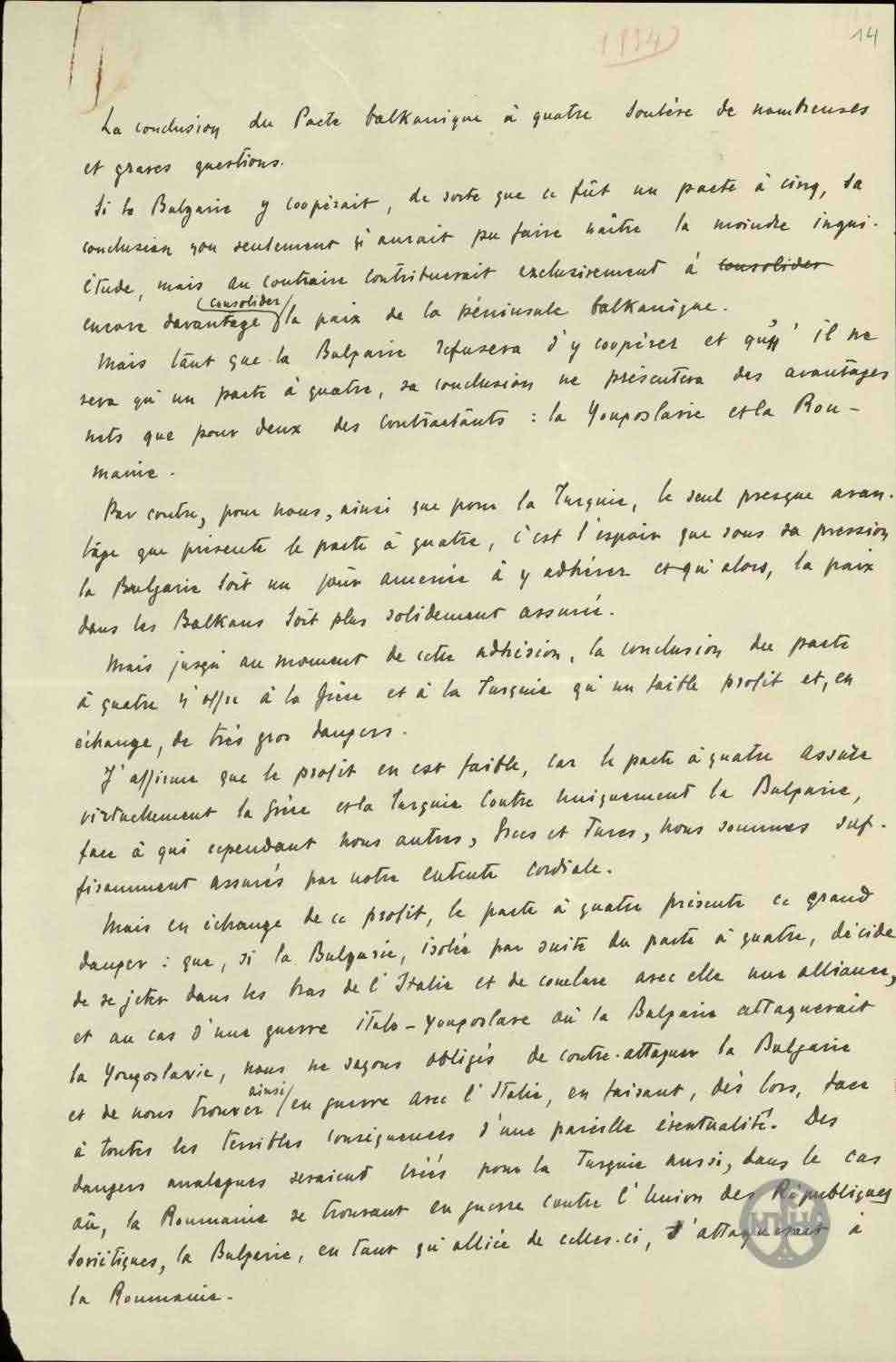
Original text (diplomatic transcription)
OCR: passed checks · claude/opus
La conclusion du Pacte balkanique à quatre soulève de nombreuses
et graves questions.
Si la Bulgarie y coopérait, de sorte que ce fût un pacte à cinq, sa
conclusion non seulement n'aurait pu faire naître la moindre inqui-
étude, mais au contraire contribuerait exclusivement à ~~consolider~~
encore davantage ⸌consolider⸍ la paix de la péninsule balkanique.
Mais tant que la Bulgarie refusera d'y coopérer et qu'il ne
sera qu'un pacte à quatre, sa conclusion ne présentera des avantages
nets que pour deux des contractants : la Yougoslavie et la Rou-
manie.
Par contre, pour nous, ainsi que pour la Turquie, le seul presque avan-
tage que présente le pacte à quatre, c'est l'espoir que sous sa pression
la Bulgarie soit un jour amenée à y adhérer et qu'alors, la paix
dans les Balkans soit plus solidement assurée.
Mais jusqu'au moment de cette adhésion, la conclusion du pacte
à quatre n'offre à la Grèce et à la Turquie qu'un faible profit et, en
échange, de très gros dangers.
J'affirme que le profit en est faible, car le pacte à quatre assure
virtuellement la Grèce et la Turquie contre uniquement la Bulgarie,
face à qui cependant nous autres, Grecs et Turcs, nous sommes suf-
fisamment assurés par notre entente cordiale.
Mais en échange de ce profit, le pacte à quatre présente ce grand
danger : que, si la Bulgarie, isolée par suite du pacte à quatre, décide
de se jeter dans les bras de l'Italie et de conclure avec elle une alliance,
et au cas d'une guerre Italo-Yougoslave où la Bulgarie attaquerait
la Yougoslavie, nous ne serons obligés de contre-attaquer la Bulgarie
et de nous trouver ⸌ainsi⸍ en guerre avec l'Italie, en faisant, dès lors, face
à toutes les terribles conséquences d'une pareille éventualité. Des
dangers analogues seraient créés pour la Turquie aussi, dans le cas
où, la Roumanie se trouvant en guerre contre l'Union des Républiques
soviétiques, la Bulgarie, en tant qu'alliée de celles-ci, s'attaquerait à
la Roumanie.
Stamps and notes
- handwritten_note (1934) top centre, red pencil
- archival 14 top right corner, folio number
- stamp circular collection stamp (Greek lettering, partly legible) right margin, lower part, overlapping the last lines
- other Editorial conventions: ~~…~~ marks a word struck through by the author ('consolider', end of line 5). ⸌…⸍ marks an interlinear insertion written above the line with a caret or slash ('consolider' in line 6, 'ainsi' in line 27). —
Uncertain readings
- qu'il Letters after 'qu' are cramped or partly overwritten; 'qu'il' is the probable reading.
- fisamment Continuation of 'suf-' at the line break; the letters are unclear, and the word may be written 'fisamment' or 'fissamment'.
- Italo-Yougoslave Capitalisation of both elements is uncertain.
- ne A short word appears between 'nous' and 'serons' and reads as 'ne'. The sense suggests it may be a slip or a correction.
- s'attaquerait The initial letter or elision is unclear and partly obscured by the stamp. It could be read as 'd'attaquerait' or 'attaquerait'.
Demotic Greek
Η σύναψη του Βαλκανικού Συμφώνου των τεσσάρων εγείρει πολλά και σοβαρά ζητήματα.
Αν η Βουλγαρία συμμετείχε σε αυτό, ώστε να γίνει σύμφωνο των πέντε, η σύναψή του όχι μόνο δεν θα μπορούσε να προκαλέσει την παραμικρή ανησυχία, αλλά αντίθετα θα συνέβαλλε αποκλειστικά στο να ενισχυθεί ακόμη περισσότερο η ειρήνη της βαλκανικής χερσονήσου.
Όσο όμως η Βουλγαρία θα αρνείται να συνεργαστεί και το σύμφωνο δεν θα είναι παρά σύμφωνο των τεσσάρων, η σύναψή του δεν θα παρουσιάζει καθαρά πλεονεκτήματα παρά μόνο για δύο από τους συμβαλλομένους: τη Γιουγκοσλαβία και τη Ρουμανία.
Αντίθετα, για εμάς, όπως και για την Τουρκία, το σχεδόν μοναδικό πλεονέκτημα που παρουσιάζει το σύμφωνο των τεσσάρων είναι η ελπίδα ότι, υπό την πίεσή του, η Βουλγαρία θα οδηγηθεί κάποτε να προσχωρήσει και ότι τότε η ειρήνη στα Βαλκάνια θα εξασφαλιστεί πιο στέρεα.
Μέχρι τη στιγμή όμως αυτής της προσχώρησης, η σύναψη του συμφώνου των τεσσάρων προσφέρει στην Ελλάδα και την Τουρκία ένα μικρό όφελος και, σε αντάλλαγμα, πολύ μεγάλους κινδύνους.
Διατείνομαι ότι το όφελος είναι μικρό, διότι το σύμφωνο των τεσσάρων εξασφαλίζει ουσιαστικά την Ελλάδα και την Τουρκία μόνο απέναντι στη Βουλγαρία, απέναντι στην οποία ωστόσο εμείς, Έλληνες και Τούρκοι, είμαστε επαρκώς εξασφαλισμένοι χάρη στη φιλική μας συνεννόηση.
Σε αντάλλαγμα όμως αυτού του οφέλους, το σύμφωνο των τεσσάρων παρουσιάζει τον εξής μεγάλο κίνδυνο: αν η Βουλγαρία, απομονωμένη εξαιτίας του συμφώνου των τεσσάρων, αποφασίσει να ριχτεί στην αγκαλιά της Ιταλίας και να συνάψει μαζί της συμμαχία, και σε περίπτωση ιταλο-γιουγκοσλαβικού πολέμου, κατά τον οποίο η Βουλγαρία θα επιτίθετο εναντίον της Γιουγκοσλαβίας, θα είμαστε υποχρεωμένοι να αντεπιτεθούμε εναντίον της Βουλγαρίας και να βρεθούμε έτσι σε πόλεμο με την Ιταλία, αντιμετωπίζοντας εφεξής όλες τις τρομερές συνέπειες μιας τέτοιας ενδεχόμενης εξέλιξης. Ανάλογοι κίνδυνοι θα δημιουργούνταν και για την Τουρκία, στην περίπτωση που, ενώ η Ρουμανία βρίσκεται σε πόλεμο εναντίον της Ένωσης των Σοβιετικών Δημοκρατιών, η Βουλγαρία, ως σύμμαχος αυτών, επιτεθεί εναντίον της Ρουμανίας.
Turkish
Dörtlü Balkan Paktı'nın akdi birçok ciddi sorunu gündeme getirmektedir.
Bulgaristan da buna katılsaydı ve pakt beşli olsaydı, akdi en küçük bir kaygıya yol açmayacak, aksine yalnızca Balkan yarımadasının barışını daha da pekiştirmeye katkıda bulunacaktı.
Ancak Bulgaristan buna katılmayı reddettiği ve pakt yalnızca dörtlü bir pakt olarak kaldığı sürece, akdi yalnızca iki akit taraf için, yani Yugoslavya ve Romanya için net yararlar sağlayacaktır.
Buna karşılık, bizim için ve Türkiye için dörtlü paktın sunduğu hemen hemen tek yarar, onun baskısı altında Bulgaristan'ın bir gün buna katılmaya yönlendirileceği ve o zaman Balkanlar'da barışın daha sağlam biçimde güvence altına alınacağı umududur.
Ancak bu katılım anına kadar, dörtlü paktın akdi Yunanistan'a ve Türkiye'ye yalnızca zayıf bir kazanç, karşılığında ise çok büyük tehlikeler sunmaktadır.
Kazancın zayıf olduğunu ileri sürüyorum; çünkü dörtlü pakt, Yunanistan'ı ve Türkiye'yi fiilen yalnızca Bulgaristan'a karşı güvence altına almaktadır; oysa biz Yunanlılar ve Türkler, ona karşı içten anlaşmamız (entente cordiale) sayesinde yeterince güvendeyiz.
Ancak bu kazanç karşılığında dörtlü pakt şu büyük tehlikeyi taşımaktadır: Dörtlü pakt yüzünden yalnız kalan Bulgaristan kendisini İtalya'nın kollarına atmaya ve onunla bir ittifak akdetmeye karar verirse ve Bulgaristan'ın Yugoslavya'ya saldıracağı bir İtalyan-Yugoslav savaşı halinde, biz Bulgaristan'a karşı karşı saldırıya geçmek zorunda kalacağız ve böylece İtalya ile savaş halinde bulunacağız; dolayısıyla böyle bir ihtimalin bütün korkunç sonuçlarıyla karşı karşıya kalacağız. Romanya'nın Sovyet Cumhuriyetleri Birliği ile savaşta bulunduğu ve Bulgaristan'ın bunların müttefiki olarak Romanya'ya saldırdığı bir durumda, Türkiye için de benzer tehlikeler doğardı.
English
The conclusion of the four-party Balkan Pact raises numerous and grave questions.
If Bulgaria were to cooperate in it, so that it would be a five-party pact, its conclusion would not only have given rise to no anxiety whatever, but would, on the contrary, contribute exclusively to consolidating still further the peace of the Balkan Peninsula.
But so long as Bulgaria refuses to cooperate in it and it remains only a four-party pact, its conclusion will present clear advantages for only two of the contracting parties: Yugoslavia and Romania.
For us, on the other hand, as for Turkey, almost the only advantage that the four-party pact offers is the hope that under its pressure Bulgaria may one day be brought to adhere to it and that the peace of the Balkans will then be more firmly assured.
But until the moment of that adherence, the conclusion of the four-party pact offers Greece and Turkey only a slight benefit and, in exchange, very great dangers.
I affirm that the benefit is slight, for the four-party pact virtually secures Greece and Turkey only against Bulgaria, in the face of which, however, we Greeks and Turks are sufficiently secured by our cordial understanding.
But in exchange for this benefit, the four-party pact presents this great danger: that, if Bulgaria, isolated as a result of the four-party pact, decides to throw herself into the arms of Italy and to conclude an alliance with her, then in the event of an Italo-Yugoslav war in which Bulgaria were to attack Yugoslavia, we shall be obliged to counter-attack Bulgaria and thus to find ourselves at war with Italy, thereby facing all the terrible consequences of such an eventuality. Analogous dangers would be created for Turkey also, in the case where, Romania being at war against the Union of Soviet Republics, Bulgaria, as an ally of the latter, were to attack Romania.
Open issues
| p. | Kind | Language | Text | Detail |
|---|---|---|---|---|
| 1 | uncertain_reading | qu'il | Letters after 'qu' are cramped or partly overwritten; 'qu'il' is the probable reading. | |
| 1 | uncertain_reading | fisamment | Continuation of 'suf-' at the line break; the letters are unclear, and the word may be written 'fisamment' or 'fissamment'. | |
| 1 | uncertain_reading | Italo-Yougoslave | Capitalisation of both elements is uncertain. | |
| 1 | uncertain_reading | ne | A short word appears between 'nous' and 'serons' and reads as 'ne'. The sense suggests it may be a slip or a correction. | |
| 1 | uncertain_reading | s'attaquerait | The initial letter or elision is unclear and partly obscured by the stamp. It could be read as 'd'attaquerait' or 'attaquerait'. | |
| 1 | translation_uncertain_source | el | et qu'il ne sera qu'un pacte à quatre | Το ⟦qu'il⟧ είναι αβέβαιη ανάγνωση. Αποδόθηκε ως ⟦το σύμφωνο⟧ για να στέκει η σύνταξη στα ελληνικά. |
| 1 | translation_uncertain_source | el | nous ne serons obligés de contre-attaquer | Η αρνητική μόριο «ne» (αβέβαιη ανάγνωση) αντιφάσκει με το νόημα, που απαιτεί υποχρέωση αντεπίθεσης. Παραλείφθηκε στη μετάφραση και χρειάζεται έλεγχος στο πρωτότυπο. |
| 1 | translation_uncertain_source | el | consolider (διαγραμμένο) … ⸌consolider⸍ | Ο συντάκτης διέγραψε το «consolider» και το ξαναέγραψε πάνω από τη γραμμή, μετά το «encore davantage». Αποδόθηκε η τελική μορφή. |
| 1 | translation_uncertain_source | tr | qu'il ne sera qu'un pacte à quatre | Belirsiz okuma: 'il' zamiri paktı gösteriyor kabul edilerek ⟦pakt⟧ biçiminde çevrildi. |
| 1 | translation_uncertain_source | tr | contribuerait exclusivement à ~~consolider~~ encore davantage ⸌consolider⸍ | Kaynakta 'consolider' çizilmiş ve 'encore davantage' sözcüklerinden sonra satır üstüne yeniden eklenmiştir; çeviri düzeltilmiş son okumayı izler. |
| 1 | translation_uncertain_source | tr | nous ne serons obligés de contre-attaquer | Belirsiz okunan 'ne' olumsuzlama olarak alınırsa anlam tersine döner ('zorunda kalmayacağız'). Bağlam (zorunluluk ve tehlike vurgusu) nedeniyle 'zorunda kalacağız' biçiminde çevrilmiş, belirsizlik işareti korunmuştur. |
| 1 | translation_term | tr | entente cordiale | Yunan-Türk dostluğuna atıfla kullanılan ifade; sözlükte yer alan İtilaf Devletleri (Entente) ile ilgisi yoktur. 'İçten anlaşma (entente cordiale)' olarak çevrildi. |
| 1 | translation_uncertain_source | en | le seul presque avantage | Awkward word order in the source ("the only almost advantage"); rendered as "the only, almost, advantage", i.e. "almost the only advantage". |
| 1 | translation_uncertain_source | en | nous ne serons obligés | The uncertain reading "ne" is a negative particle, but the sense (Greece would be obliged to counter-attack) requires no negation. Rendered without negation, with the doubtful word marked as ⟦(ne)⟧. |
| 1 | translation_uncertain_source | en | fisamment | The word is split across the line break (suf-/fisamment); only the second part is marked uncertain, and the whole word is rendered within the marks. |