Report on the Balkan Peace Pact
173.351.14 · <1934> · Γαλλική · machine-generated, not reviewed
Scan
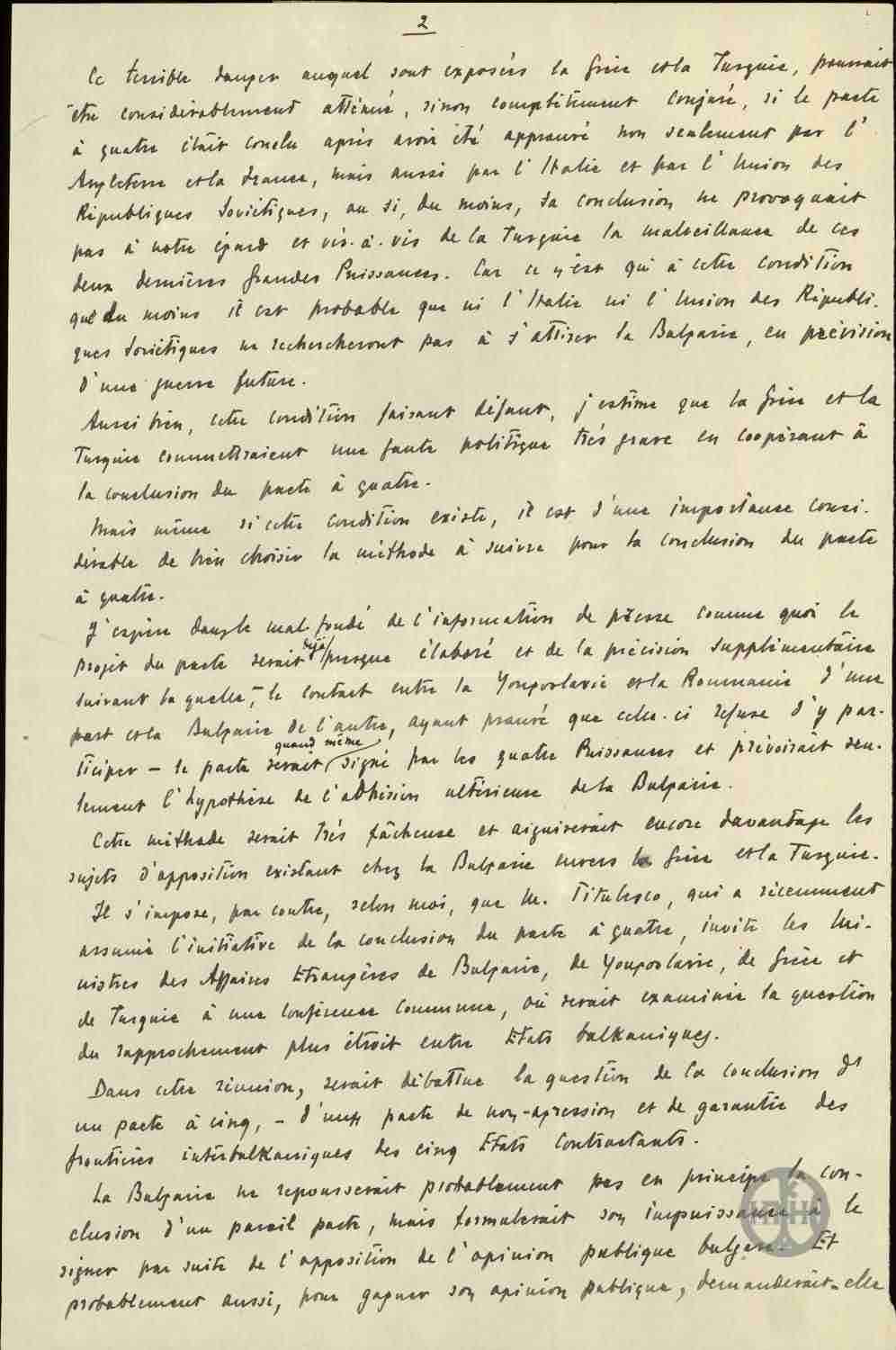
Original text (diplomatic transcription)
OCR: passed checks · claude/opus
le terrible danger auquel sont exposées la Grèce et la Turquie, pourrait
être considérablement atténué, sinon complètement conjuré, si le pacte
à quatre était conclu après avoir été approuvé non seulement par l'
Angleterre et la France, mais aussi par l'Italie et par l'Union des
Républiques Soviétiques, ou si, du moins, sa conclusion ne provoquait
pas à notre égard et vis-à-vis de la Turquie la malveillance de ces
deux dernières Grandes Puissances. Car ce n'est qu'à cette condition
que du moins il est probable que ni l'Italie ni l'Union des Républi-
ques Soviétiques ne rechercheront pas à s'attirer la Bulgarie, en prévision
d'une guerre future.
Aussi bien, cette condition faisant défaut, j'estime que la Grèce et la
Turquie commettraient une faute politique très grave en coopérant à
la conclusion du pacte à quatre.
Mais même si cette condition existe, il est d'une importance consi-
dérable de bien choisir la méthode à suivre pour la conclusion du pacte
à quatre.
J'exprime donc le mal-fondé de l'information de presse comme quoi le
projet du pacte serait déjà presque élaboré et de la précision supplémentaire
suivant laquelle, le contact entre la Yougoslavie et la Roumanie d'une
part et la Bulgarie de l'autre, ayant prouvé que celle-ci refuse d'y par-
ticiper – le pacte serait quand même signé par les quatre Puissances et prévoirait seu-
lement l'hypothèse de l'adhésion ultérieure de la Bulgarie.
Cette méthode serait très fâcheuse et aiguiserait encore davantage les
sujets d'opposition existant chez la Bulgarie envers la Grèce et la Turquie.
Il s'impose, par contre, selon moi, que M. Titulesco, qui a récemment
assumé l'initiative de la conclusion du pacte à quatre, invite les Mi-
nistres des Affaires Etrangères de Bulgarie, de Yougoslavie, de Grèce et
de Turquie à une conférence commune, où serait examinée la question
du rapprochement plus étroit entre Etats balkaniques.
Dans cette réunion, serait débattue la question de la conclusion d'
un pacte à cinq, – d'un pacte de non-agression et de garantie des
frontières interbalkaniques des cinq Etats contractants.
La Bulgarie ne repousserait probablement pas en principe la con-
clusion d'un pareil pacte, mais formulerait son impuissance à le
signer par suite de l'opposition de l'opinion publique bulgare. Et
probablement aussi, pour gagner son opinion publique, demanderait-elle
Stamps and notes
- handwritten_note 2 top centre, underlined page number
- stamp ΜΠΗ bottom right margin, overlapping the text near "à le"
Uncertain readings
- donc le Word(s) after "J'exprime" hard to read; could be "doute" or "dans le".
- déjà Small word written above the line before "presque"; reading tentative.
- quand même Interlinear insertion written above "serait" / "signé", placed inline here.
Demotic Greek
ο τρομερός κίνδυνος στον οποίο εκτίθενται η Ελλάδα και η Τουρκία θα μπορούσε να μετριαστεί σημαντικά, αν όχι να αποτραπεί πλήρως, αν το σύμφωνο των τεσσάρων συναπτόταν αφού πρώτα εγκριθεί όχι μόνο από την Αγγλία και τη Γαλλία, αλλά και από την Ιταλία και την Ένωση των Σοβιετικών Δημοκρατιών, ή αν, τουλάχιστον, η σύναψή του δεν προκαλούσε απέναντι σε εμάς και απέναντι στην Τουρκία τη δυσμένεια των δύο τελευταίων αυτών Μεγάλων Δυνάμεων. Διότι μόνο υπό αυτή την προϋπόθεση είναι τουλάχιστον πιθανό ότι ούτε η Ιταλία ούτε η Ένωση των Σοβιετικών Δημοκρατιών θα επιδιώξουν να προσεταιριστούν τη Βουλγαρία, εν όψει ενός μελλοντικού πολέμου.
Γι' αυτό, ελλείψει της προϋπόθεσης αυτής, κρίνω ότι η Ελλάδα και η Τουρκία θα διέπρατταν ένα πολύ σοβαρό πολιτικό σφάλμα αν συνεργάζονταν στη σύναψη του συμφώνου των τεσσάρων.
Αλλά ακόμη κι αν η προϋπόθεση αυτή υπάρχει, έχει τεράστια σημασία να επιλεγεί σωστά η μέθοδος που θα ακολουθηθεί για τη σύναψη του συμφώνου των τεσσάρων.
Εκφράζω λοιπόν την αβασιμότητα της είδησης του Τύπου ότι το σχέδιο του συμφώνου θα ήταν ήδη σχεδόν έτοιμο, καθώς και της συμπληρωματικής διευκρίνισης σύμφωνα με την οποία, αφού η επαφή μεταξύ της Γιουγκοσλαβίας και της Ρουμανίας αφενός και της Βουλγαρίας αφετέρου απέδειξε ότι η τελευταία αρνείται να συμμετάσχει, το σύμφωνο θα υπογραφόταν παρ' όλα αυτά από τις τέσσερις Δυνάμεις και θα προέβλεπε μόνο το ενδεχόμενο της μεταγενέστερης προσχώρησης της Βουλγαρίας.
Η μέθοδος αυτή θα ήταν πολύ ατυχής και θα όξυνε ακόμη περισσότερο τα θέματα αντίθεσης που υπάρχουν στη Βουλγαρία έναντι της Ελλάδας και της Τουρκίας.
Αντίθετα, επιβάλλεται κατά τη γνώμη μου ο κ. Τιτουλέσκου, ο οποίος ανέλαβε πρόσφατα την πρωτοβουλία για τη σύναψη του συμφώνου των τεσσάρων, να καλέσει τους Υπουργούς των Εξωτερικών της Βουλγαρίας, της Γιουγκοσλαβίας, της Ελλάδας και της Τουρκίας σε κοινή διάσκεψη, όπου θα εξεταζόταν το ζήτημα της στενότερης προσέγγισης μεταξύ των βαλκανικών κρατών.
Στη σύσκεψη αυτή θα συζητιόταν το ζήτημα της σύναψης συμφώνου των πέντε, – συμφώνου μη επίθεσης και εγγύησης των διαβαλκανικών συνόρων των πέντε συμβαλλομένων κρατών.
Η Βουλγαρία πιθανότατα δεν θα απέρριπτε κατ' αρχήν τη σύναψη ενός τέτοιου συμφώνου, αλλά θα διατύπωνε αδυναμία να το υπογράψει εξαιτίας της αντίθεσης της βουλγαρικής κοινής γνώμης. Και πιθανότατα επίσης, για να κερδίσει την κοινή γνώμη της, θα ζητούσε
Turkish
Yunanistan'ın ve Türkiye'nin maruz kaldığı korkunç tehlike, dörtlü pakt yalnızca İngiltere ve Fransa tarafından değil, İtalya ve Sovyet Cumhuriyetleri Birliği tarafından da onaylandıktan sonra akdedilirse, ya da en azından akdi bize ve Türkiye'ye karşı bu son iki Büyük Devletin hoşnutsuzluğuna yol açmazsa, tamamen bertaraf edilemese bile önemli ölçüde hafifletilebilirdi. Çünkü ancak bu koşulla, en azından ne İtalya'nın ne de Sovyet Cumhuriyetleri Birliği'nin, gelecekteki bir savaş ihtimaline karşı Bulgaristan'ı kendi yanlarına çekmeye çalışmayacakları muhtemeldir.
Bu koşul eksik olduğu takdirde ise, Yunanistan'ın ve Türkiye'nin dörtlü paktın akdine katılmakla çok ağır bir siyasi hata işleyeceği kanısındayım.
Ancak bu koşul var olsa bile, dörtlü paktın akdi için izlenecek yöntemin iyi seçilmesi büyük önem taşımaktadır.
Bu nedenle pakt taslağının şimdiden hemen hemen hazırlanmış olduğuna dair basın haberinin ve ayrıca şu ek bilginin asılsızlığını dile getiriyorum: Yugoslavya ile Romanya'nın bir yanda, Bulgaristan'ın öte yanda temasa geçmesi Bulgaristan'ın katılmayı reddettiğini göstermiş olduğundan, pakt yine de dört Devlet tarafından imzalanacak ve yalnızca Bulgaristan'ın sonradan katılması ihtimalini öngörecekmiş.
Bu yöntem çok sakıncalı olurdu ve Bulgaristan'da Yunanistan'a ve Türkiye'ye karşı var olan karşıtlık konularını daha da keskinleştirirdi.
Buna karşılık bana göre şu zorunludur: Dörtlü paktın akdi girişimini yakın zamanda üstlenmiş olan Bay Titulesco, Bulgaristan, Yugoslavya, Yunanistan ve Türkiye Dışişleri Bakanlarını ortak bir konferansa davet etmelidir; bu konferansta Balkan Devletleri arasında daha sıkı bir yakınlaşma meselesi incelenmelidir.
Bu toplantıda beşli bir paktın, yani beş akit Devletin Balkanlar içindeki sınırlarına ilişkin bir saldırmazlık ve güvence paktının akdi konusu görüşülürdü.
Bulgaristan, böyle bir paktın akdini ilke olarak muhtemelen reddetmezdi, ancak Bulgar kamuoyunun muhalefeti nedeniyle imzalayamayacağını ileri sürerdi. Ve muhtemelen, kamuoyunu kazanmak için, kendisine
English
the terrible danger to which Greece and Turkey are exposed could be considerably attenuated, if not completely averted, if the four-party pact were concluded after having been approved not only by England and France, but also by Italy and by the Union of Soviet Republics, or if, at least, its conclusion did not provoke towards us and towards Turkey the ill-will of these last two Great Powers. For only on this condition is it at least probable that neither Italy nor the Union of Soviet Republics will seek to attract Bulgaria to their side in anticipation of a future war.
Indeed, this condition being absent, I consider that Greece and Turkey would commit a very grave political error by cooperating in the conclusion of the four-party pact.
But even if this condition exists, it is of considerable importance to choose well the method to be followed for the conclusion of the four-party pact.
I therefore express the ill-foundedness of the press report that the draft of the pact is already almost drawn up, and of the additional detail according to which, the contact between Yugoslavia and Romania on the one hand and Bulgaria on the other having proved that the latter refuses to participate in it, the pact would nevertheless be signed by the four Powers and would provide only for the hypothesis of the subsequent adherence of Bulgaria.
This method would be most unfortunate and would sharpen still further the grounds of opposition existing in Bulgaria towards Greece and Turkey.
It is necessary, on the contrary, in my opinion, that M. Titulesco, who has recently taken the initiative in the conclusion of the four-party pact, invite the Ministers for Foreign Affairs of Bulgaria, Yugoslavia, Greece and Turkey to a joint conference, at which the question of a closer rapprochement between the Balkan States would be examined.
At this meeting the question would be debated of the conclusion of a five-party pact – a pact of non-aggression and of guarantee of the inter-Balkan frontiers of the five contracting States.
Bulgaria would probably not reject in principle the conclusion of such a pact, but would state her inability to sign it owing to the opposition of Bulgarian public opinion. And probably also, in order to win over her public opinion, she would ask
Open issues
| p. | Kind | Language | Text | Detail |
|---|---|---|---|---|
| 2 | uncertain_reading | donc le | Word(s) after "J'exprime" hard to read; could be "doute" or "dans le". | |
| 2 | uncertain_reading | déjà | Small word written above the line before "presque"; reading tentative. | |
| 2 | uncertain_reading | quand même | Interlinear insertion written above "serait" / "signé", placed inline here. | |
| 2 | translation_uncertain_source | el | le terrible danger auquel sont exposées… | Η σελίδα αρχίζει με πεζό γράμμα, δηλαδή συνεχίζει πρόταση. Πιθανόν λείπει εισαγωγική λέξη ή φράση από το τέλος της σελίδας 1. Η μετάφραση ακολουθεί το κείμενο όπως είναι. |
| 2 | translation_uncertain_source | el | J'exprime donc le mal-fondé de l'information de presse | Η σύνταξη είναι ασυνήθιστη και το ⟦donc le⟧ αβέβαιο. Πιθανόν το πρωτότυπο να είχε διαφορετική διατύπωση, π.χ. «εκφράζω αμφιβολία για τη βασιμότητα». Αποδόθηκε κατά λέξη. |
| 2 | translation_uncertain_source | tr | ni l'Italie ni l'Union des Républiques Soviétiques ne rechercheront pas | Kaynakta 'ni…ni' ile birlikte ek bir 'pas' bulunmaktadır (çift olumsuzlama); çeviri anlamı doğrultusunda 'çalışmayacakları' biçiminde verilmiştir. |
| 2 | translation_uncertain_source | en | J'exprime donc le mal-fondé de l'information de presse | The construction is odd ("I express the ill-foundedness"), perhaps a slip for "I doubt" or "I consider ill-founded". Translated literally, with the uncertain words bracketed. |
| 2 | translation_term | en | les quatre Puissances | The source uses "Puissances" for the four Balkan States, apparently loosely; kept as "Powers". |