Report on the Balkan Peace Pact
173.351.14 · <1934> · Γαλλική · machine-generated, not reviewed
Scan
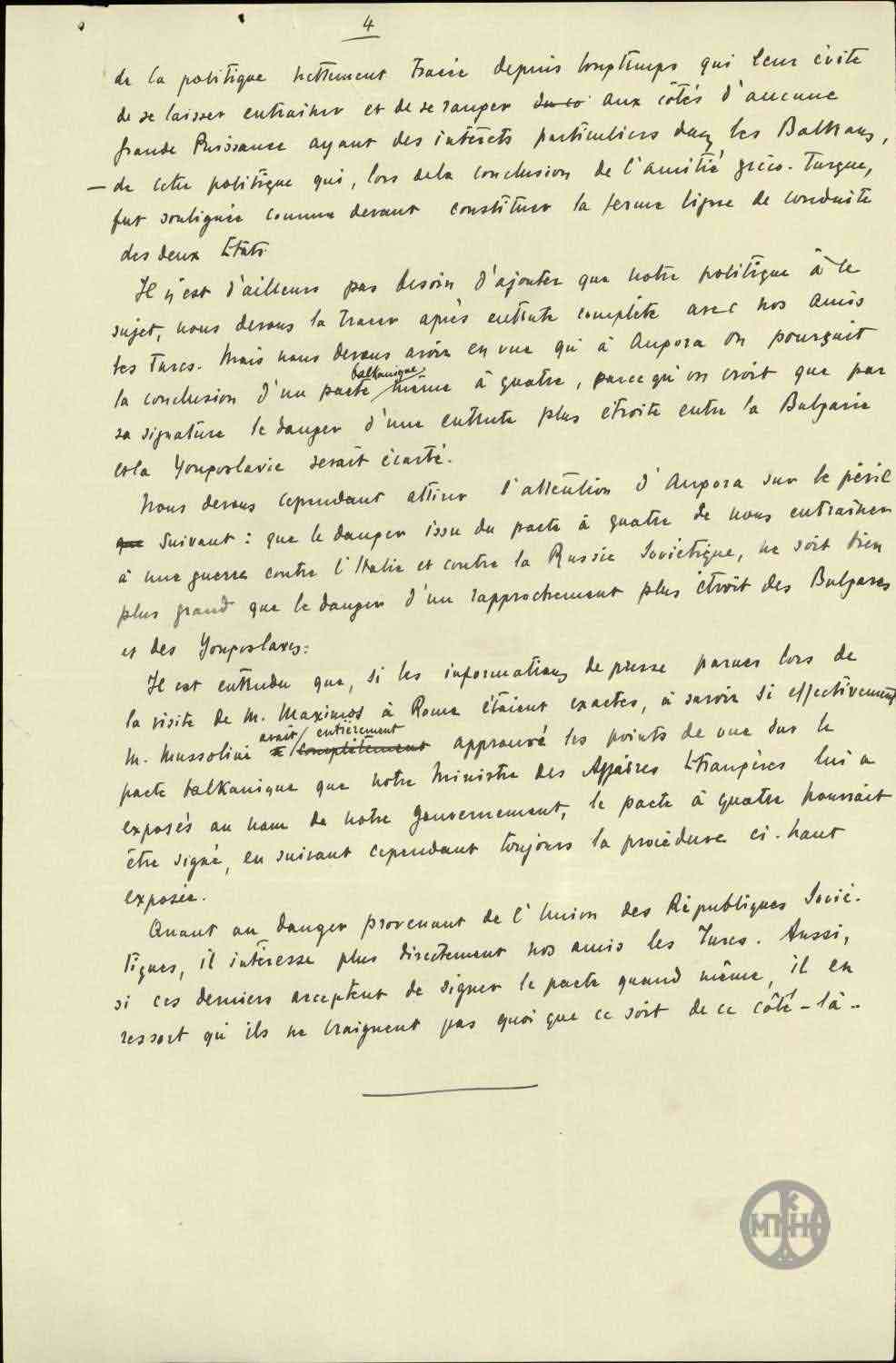
Original text (diplomatic transcription)
OCR: passed checks · claude/opus
de la politique nettement tracée depuis longtemps qui leur évite
de se laisser entraîner et de se ranger ~~du co~~ aux côtés d'aucune
Grande Puissance ayant des intérêts particuliers dans les Balkans,
— de cette politique qui, lors de la conclusion de l'amitié gréco-turque,
fut soulignée comme devant constituer la ferme ligne de conduite
des deux Etats.
Il n'est d'ailleurs pas besoin d'ajouter que notre politique à ce
sujet, nous devons la tracer après entente complète avec nos amis
les Turcs. Mais nous devons avoir en vue qu'à Angora on poursuit
la conclusion d'un pacte balkanique ~~même~~ à quatre, parce qu'on croit que par
sa signature le danger d'une entente plus étroite entre la Bulgarie
et la Yougoslavie serait écarté.
Nous devons cependant attirer l'attention d'Angora sur le péril
~~que~~ suivant : que le danger issu du pacte à quatre de nous entraîner
à une guerre contre l'Italie et contre la Russie Soviétique, ne soit bien
plus grand que le danger d'un rapprochement plus étroit des Bulgares
et des Yougoslaves.
Il est entendu que, si les informations de presse parues lors de
la visite de M. Maximos à Rome étaient exactes, à savoir si effectivement
M. Mussolini ~~a~~ avait entièrement ~~complètement~~ approuvé les points de vue sur le
pacte balkanique que notre Ministre des Affaires Etrangères lui a
exposés au nom de notre Gouvernement, le pacte à quatre pouvait
être signé, en suivant cependant toujours la procédure ci-haut
exposée.
Quant au danger provenant de l'Union des Républiques Sovié-
tiques, il intéresse plus directement nos amis les Turcs. Aussi,
si ces derniers acceptent de signer le pacte quand même, il en
ressort qu'ils ne craignent pas quoi que ce soit de ce côté-là.
Stamps and notes
- other 4 top centre, underlined page number
- other horizontal line closing the text bottom centre, below the last line
- stamp ΜΠΗ bottom right, Benaki Museum collection stamp
Uncertain readings
- évite Word at end of line 1 is unclear in the hand; could also be read as 'coûte'. 'évite' fits the sense.
- ~~du co~~ Struck-through words, line 2; ~~…~~ marks deletions throughout.
- ~~⟦même⟧~~ Struck-through word with 'balkanique' written above it as an interlinear insertion; the deleted word is barely legible.
- ~~⟦a⟧~~ avait entièrement ~~complètement~~ 'avait' and 'entièrement' are interlinear insertions above a struck short word (possibly 'a' or 'x') and a struck 'complètement'.
- ~~que~~ Struck-through short word at the start of the line before 'suivant'.
- Etats. The final punctuation is faint.
- côté-là. The line ends with a dot or dots and a short dash; the exact punctuation is unclear.
- accents Accents and diacritics in the handwriting are often ambiguous. They are transcribed as they most likely appear.
Demotic Greek
από την πολιτική που έχει χαραχτεί σαφώς εδώ και πολύ καιρό και τους γλιτώνει από το να παρασυρθούν και να συνταχθούν στο πλευρό οποιασδήποτε Μεγάλης Δύναμης που έχει ιδιαίτερα συμφέροντα στα Βαλκάνια, — από την πολιτική εκείνη που, κατά τη σύναψη της ελληνοτουρκικής φιλίας, τονίστηκε ότι θα αποτελεί τη σταθερή γραμμή πορείας των δύο κρατών.
Δεν χρειάζεται άλλωστε να προσθέσω ότι την πολιτική μας ως προς το θέμα αυτό οφείλουμε να τη χαράξουμε έπειτα από πλήρη συνεννόηση με τους φίλους μας τους Τούρκους. Πρέπει όμως να έχουμε υπόψη ότι στην Άγκυρα επιδιώκουν τη σύναψη βαλκανικού συμφώνου των τεσσάρων, επειδή πιστεύουν ότι με την υπογραφή του θα απομακρυνθεί ο κίνδυνος στενότερης συνεννόησης μεταξύ της Βουλγαρίας και της Γιουγκοσλαβίας.
Πρέπει ωστόσο να επιστήσουμε την προσοχή της Άγκυρας στον εξής κίνδυνο: μήπως ο κίνδυνος που προκύπτει από το σύμφωνο των τεσσάρων, δηλαδή να παρασυρθούμε σε πόλεμο εναντίον της Ιταλίας και της Σοβιετικής Ρωσίας, είναι πολύ μεγαλύτερος από τον κίνδυνο μιας στενότερης προσέγγισης των Βουλγάρων και των Γιουγκοσλάβων.
Είναι αυτονόητο ότι, αν οι ειδήσεις του Τύπου που δημοσιεύθηκαν κατά την επίσκεψη του κ. Μάξιμου στη Ρώμη ήταν ακριβείς, δηλαδή αν πράγματι ο κ. Μουσολίνι είχε εγκρίνει πλήρως τις απόψεις για το βαλκανικό σύμφωνο που ο Υπουργός των Εξωτερικών μας του εξέθεσε εξ ονόματος της Κυβέρνησής μας, το σύμφωνο των τεσσάρων μπορούσε να υπογραφεί, ακολουθώντας ωστόσο πάντοτε τη διαδικασία που εκτέθηκε ανωτέρω.
Ως προς τον κίνδυνο που προέρχεται από την Ένωση των Σοβιετικών Δημοκρατιών, αυτός ενδιαφέρει πιο άμεσα τους φίλους μας τους Τούρκους. Γι' αυτό, αν οι τελευταίοι δέχονται να υπογράψουν το σύμφωνο παρ' όλα αυτά, συνάγεται ότι δεν φοβούνται τίποτα από την πλευρά εκείνη.
Turkish
anlamına geldiği biçiminde değerlendirilme tehlikesi taşırdı: uzun zamandan beri açıkça çizilmiş olan ve onları Balkanlar'da özel çıkarları bulunan herhangi bir Büyük Devletin peşinden sürüklenmekten ve yanında yer almaktan alıkoyan politikadan; Yunan-Türk dostluğunun akdi sırasında iki Devletin sağlam davranış çizgisini oluşturması gerektiği vurgulanmış olan o politikadan.
Bunun yanında, bu konudaki politikamızı Türk dostlarımızla tam bir anlaşmanın ardından çizmemiz gerektiğini eklemeye gerek yoktur. Ancak şunu göz önünde bulundurmalıyız: Angora'da dörtlü bir Balkan paktının akdi izlenmektedir, çünkü bunun imzalanmasıyla Bulgaristan ile Yugoslavya arasında daha sıkı bir anlaşma tehlikesinin ortadan kalkacağına inanılmaktadır.
Bununla birlikte Angora'nın dikkatini şu tehlikeye çekmeliyiz: Dörtlü paktın bizi İtalya'ya ve Sovyet Rusya'ya karşı bir savaşa sürükleme tehlikesi, Bulgarlar ile Yugoslavların daha sıkı bir yakınlaşması tehlikesinden çok daha büyük olmasın.
Şüphesiz, Bay Maximos'un Roma ziyareti sırasında çıkan basın haberleri doğruysa, yani Bay Mussolini gerçekten de Dışişleri Bakanımızın Hükûmetimiz adına kendisine açıkladığı Balkan paktına ilişkin görüşleri tamamen onaylamışsa, dörtlü pakt imzalanabilirdi; ancak bu, her zaman yukarıda açıklanan usule uyularak olmalıdır.
Sovyet Cumhuriyetleri Birliği'nden gelen tehlikeye gelince, bu, Türk dostlarımızı daha doğrudan ilgilendirmektedir. Dolayısıyla, bunlar paktı yine de imzalamayı kabul ediyorlarsa, bu taraftan herhangi bir şeyden çekinmedikleri sonucu çıkar.
English
from the policy clearly traced long ago, which spares them from letting themselves be drawn in and from ranging themselves at the side of any Great Power having particular interests in the Balkans – that policy which, at the time of the conclusion of the Greco-Turkish friendship, was emphasised as having to constitute the firm line of conduct of the two States.
It is moreover needless to add that our policy on this subject we must trace after complete agreement with our friends the Turks. But we must bear in mind that at Angora the conclusion of a four-party Balkan pact is being pursued because it is believed that by its signature the danger of a closer understanding between Bulgaria and Yugoslavia would be removed.
We must nevertheless draw Angora's attention to the following peril: that the danger arising from the four-party pact of drawing us into a war against Italy and against Soviet Russia may be far greater than the danger of a closer rapprochement between the Bulgarians and the Yugoslavs.
It is understood that, if the press reports which appeared on the occasion of M. Maximos's visit to Rome were accurate, that is to say, if M. Mussolini had indeed entirely approved the views on the Balkan pact which our Minister for Foreign Affairs expounded to him in the name of our Government, the four-party pact could be signed, always following, however, the procedure set out above.
As for the danger arising from the Union of Soviet Republics, it concerns our friends the Turks more directly. Hence, if the latter agree to sign the pact all the same, it follows that they fear nothing whatever from that quarter.
Open issues
| p. | Kind | Language | Text | Detail |
|---|---|---|---|---|
| 4 | uncertain_reading | évite | Word at end of line 1 is unclear in the hand; could also be read as 'coûte'. 'évite' fits the sense. | |
| 4 | uncertain_reading | ~~du co~~ | Struck-through words, line 2; ~~…~~ marks deletions throughout. | |
| 4 | uncertain_reading | ~~même~~ | Struck-through word with 'balkanique' written above it as an interlinear insertion; the deleted word is barely legible. | |
| 4 | uncertain_reading | ~~a~~ avait entièrement ~~complètement~~ | 'avait' and 'entièrement' are interlinear insertions above a struck short word (possibly 'a' or 'x') and a struck 'complètement'. | |
| 4 | uncertain_reading | ~~que~~ | Struck-through short word at the start of the line before 'suivant'. | |
| 4 | uncertain_reading | Etats. | The final punctuation is faint. | |
| 4 | uncertain_reading | côté-là. | The line ends with a dot or dots and a short dash; the exact punctuation is unclear. | |
| 4 | uncertain_reading | accents | Accents and diacritics in the handwriting are often ambiguous. They are transcribed as they most likely appear. | |
| 4 | translation_term | el | Angora | Το ιστορικό όνομα της Άγκυρας. Αποδόθηκε με το σημερινό όνομα της πόλης, ως τόπος της τουρκικής κυβέρνησης. |
| 4 | translation_uncertain_source | el | qui leur évite de se laisser entraîner | Αβέβαιη ανάγνωση του «évite». Αποδόθηκε ως ⟦τους γλιτώνει⟧ από το να παρασυρθούν. |
| 4 | translation_term | tr | Angora | Ankara'nın dönemin Batı dillerindeki adı; kaynakta olduğu gibi korunmuştur. |
| 4 | translation_uncertain_source | tr | qui leur évite de se laisser entraîner | Belirsiz okuma 'évite'; 'alıkoyan' olarak çevrilmiş, işaret korunmuştur. |
| 4 | translation_uncertain_source | en | qui leur évite de se laisser entraîner | Uncertain verb; the sense is that the policy spares the two States from being drawn in. Rendered "spares". |
| 4 | translation_term | en | M. Maximos | Presumably Dimitrios Maximos, then Greek Minister for Foreign Affairs (as the text implies); the source gives no first name. |